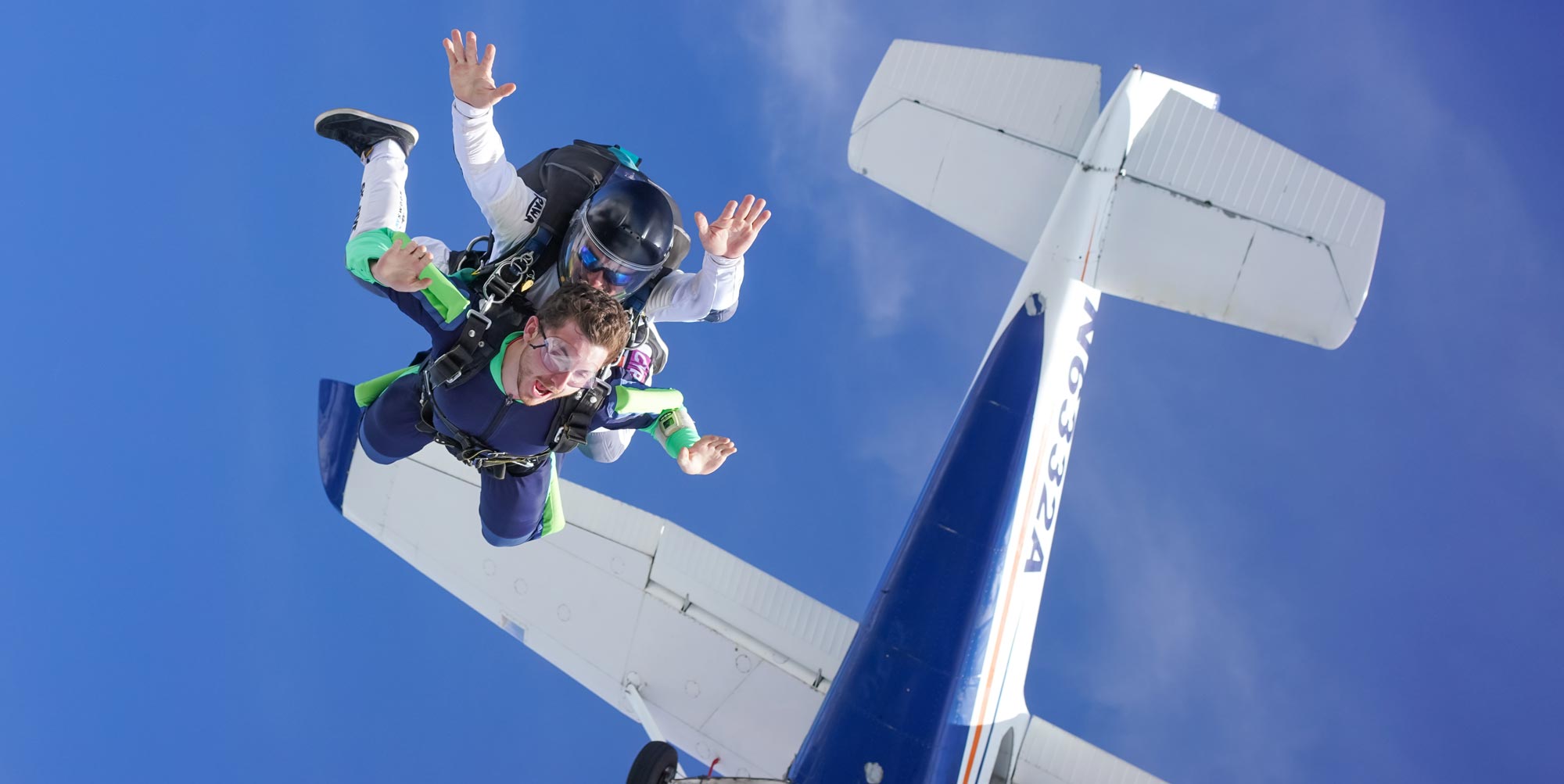
Frequently Asked Questions
Everything You Need to Know
Get ready for your big day by reading through our FAQs. If you still have questions, contact us!
The Basics
How do I get to Long Island Skydiving Center?
By car: Follow these directions.
By train: From Penn Station in Manhattan (34th St between 7th and 8th Ave) you’ll ride the Long Island Rail Road (LIRR) to the Mastic Shirley station. The ride over from the city is just over two hours, and a car or cab (MRB Taxi 631.882.4489) to the Brookhaven-Calabro Airport is about 6 minutes.
By subway: Head to Queens. Consider getting off at the Jamaica Center – Parsons/Archer Station and drive the last hour to the DZ, or – if you want to get closer first – get off at the Sutphin Blvd-Archer Av-JFK Station and then grab the LIRR at the Jamaica station and get off at Mastic Shirley. If Mastic-Shirley doesn’t have arrival and departure times that suit you, consider taking the LIRR to Ronkonkoma Station and catch an Uber to the drop zone.
How far is Long Island Skydiving Center from the Hamptons, NYC, Newark and Staten Island?
Not far at all! We’re located in Shirley, NY. By car we’re about 18 minutes from Westhampton. Depending on traffic, you can make it here in as little as an hour from NYC and about 1.5 hours from Newark and Staten Island. If you think our area is gorgeous at sea level, wait til you see it from altitude!
What are your hours of operation?
Our season runs annually from late April to early October. We take reservations from 10 am to 4 pm on Monday, Wednesday, Thursday and Friday. On Saturday and Sunday, we take reservations from 8 am to 4 pm. We’re closed every Tuesday. Jump operations may occur anytime between sunrise and sunset. If you don’t see the perfect reservation time available online, get in touch! Weather permitting, we’ll see what we can do.
If I drive, where do I park?
At the dropzone! We have plenty of free guest parking.
What happens if there’s bad weather?
As long as we have plenty of daylight ahead of us and there is hope in the forecast, we will wait it out! If necessary, we’ll reschedule or issue you a raincheck. No refunds.
Check out our article, “Skydiving Weather: What To Expect” for more information.
What is Long Island Skydiving Center's refund policy?
Pre-paid jumps and deposits are non-refundable; we will issue a raincheck if weather stops us from skydiving.
Can I reschedule my jump?
You can reschedule without penalty as long as you connect with us at least 48 hours in advance of your reservation time. Please know weekend jumps are priced differently. A $50 per-person fee applies to changes made within the 48 hour period ahead of your booking.
What if I’m late or don’t show up?
No-shows forfeit all processed payments. A $50 per-person fee is applied to those who arrive past their reservation time. To avoid penalties, contact us at least 48 hours ahead of your reservation time.
What is the relationship between Long Island Skydiving Center and Skydive Long Island?
Long Island Skydiving Center (LISC) has a long history of skydiving operations on Long Island. While Long Island Skydiving Center and Skydive Long Island (SLI) are two separate companies, both share the same ownership. In order to streamline operations and offer the best customer service, students who book through Skydive Long Island will be transferred to and will make their skydive with LISC.
Requirements
What’s the minimum age for a tandem skydive?
As mandated by the USPA and affirmed in our waivers, tandem skydivers must be at 18 years of age to skydive. Bring a valid, government-issued photo ID as proof of your date of birth.
Note, parental or guardian permission holds no validity when signing legal documents directly related to release of liability regarding tandem skydive training.
What’s the maximum age for a tandem skydive?
There isn’t one! If you are in good physical health, let’s go!
But! If you have blood pressure concerns, a heart condition, diabetes, chronic pain or other medical conditions, you may not be a good candidate for skydiving. If you’re over 70 or have health concerns, get the green light from your doctor(s) before making a reservation.
What’s the weight limit?
Our weight limit is 250 lbs for people considered height-to-weight proportionate. If you are over 200 lbs, please connect with us before making a reservation.
To accommodate requisite safety measures, an additional fee may be applied for guests over 200 lbs depending on factors such as age, height, overall physical health, body shape, and combined weight under canopy. Each guest is subject to being weighed, fully clothed and with shoes on, at our facility prior to the skydive. Above all else, safety first.
Timing
What’s the best time to skydive?
Early mornings are best! We recommend the 8:00 am time slot if it’s available. Being the first time of the day, there is no wait time allowing you to do other activities. Also, weather is rarely an interruption early in the mornings when compared to the afternoon!
In the event we’re weathered out, we can reschedule your jump or issue a raincheck. No refunds.
How far in advance should I make my reservation?
The sooner the better!
In spring and early summer, allow a few days notice for a weekday jump and a week’s notice or more for a weekend reservation. You’ll have better odds at getting your preferred time slot the earlier you make your reservation.
July and August are busiest and prime slots often fill up well in advance, leaving only early morning and evening appointment times available.
We do accept walk-ins on a space-available basis. Please call for last-minute reservations and we will do our best to get you in the air.
What time should I arrive for my jump?
Our team will contact you via email and/or text the afternoon before your appointment with details about arrival time, weather conditions, and what to bring and wear. We normally ask you to arrive 15-30 minutes prior to your reservation time and to set aside at least four hours on the day of your skydive. Arrival times can vary based on weather forecasts.
How long will I be at the DZ?
Anticipate spending 3 to 4 hours at the dropzone. If the weather is optimal, you may be with us for less time. If wind, rain or cloud cover rolls in for any part of the day, though, you may be with us longer. We do our best to get all students up as soon as possible. Please practice patience. Safety is our top priority.
Can we be in the airplane together?
Our aircraft can accommodate up to eight tandem pairs per flight. We will make every effort for you to jump with your friends, however, physics and math sometimes work against us.
Can my group jump together?
With enough lead time and good weather, yes!
Larger groups should give consideration to the time required for the full group to jump. Call us and we’ll help you find the best block for your group. Of course, the sooner you make your reservation, the higher your likelihood of booking your preferred date.
Can I SCUBA on the same day as my tandem?
Do not SCUBA dive and skydive on the same day – you could get decompression sickness. Wait at least 24 hours to jump after SCUBA, just in case.
Jump Day
What should I wear?
Choose comfortable close-fitting clothing that won’t limit your range of motion, ideally athletic wear. The temperature is 15-20 degrees cooler at altitude, so consider season-appropriate layers. Athletic shoes are best (sneakers are recommended); no heels or boots allowed. Tie back long hair to keep it out of your instructor’s face, and remove big and sentimental jewelry.
Can I wear my glasses or contacts?
Yes! We provide sanitized, skydiving goggles to every guest – including those that can fit overtop of your glasses.
Should I eat and drink before my jump?
Yes – eat normally and keep hydrated. Eating too little or too much and you may feel green around the gills. Absolutely no alcohol or other controlled substances at least 12 hours before your jump.
What should I bring?
Bring valid, government-issued photo ID to prove you’re 18+ (no ID, no jump) and the card you used for your online booking. Please keep in mind that a photo of the card is not acceptable. If paying with Apple or Google pay, we will need to see the information off the phone app. Note, vending is available on site if needed.
Can my family and friends watch me jump?
While we cannot allow spectators inside the skydiving hangar, they are welcome to watch from our designated spectator area, right by our hangar. They won’t miss a thing! There is also a cafe and public restrooms in the main terminal.
Tandem Skydiving
Is skydiving safe?
Skydiving is considered an extreme sport for good reason. Like other extreme sports, it’s all about calculated risk.
To mitigate risk, we meticulously maintain our aircraft and equipment, invest in top-of-the-line gear, engage USPA-rated tandem instructors, and adhere to stringent safety protocols.
Even so, accidents do happen. Check out our article “Is skydiving safe?” for more information.
Who is the USPA?
The United States Parachute Association (USPA) is the USA’s regulatory or governing agency serving skydivers. Skydiving centers that have pledged to abide by the skydiving safety and training standards are called Members.
Long Island Skydiving Center is a longstanding USPA Member, and all of our tandem instructors have achieved USPA-sanctioned instructional ratings.
Who will I jump with?
You’ll jump with one of our awesome, highly-experienced – and super passionate – USPA-rated tandem instructors. Getting the green light to fly tandem students involves matriculating through a stringent licensing program through the USPA, logging at least 500 jumps, and earning the USPA rating of Tandem Instructor.
Who packs the parachutes?
At Long Island Skydiving Center, all main parachutes are packed by our on-staff FAA-certificated parachute riggers or packers under the supervision of FAA-certified parachute riggers. Per Federal Aviation Administration regulations, auxiliary or reserve parachutes are inspected and repacked every 180 days.
What if I’m afraid of heights, or roller coasters?
A fear of heights often stands in the way of people making a skydive – but it’s usually unfounded. Being on a ladder, bridge or building where you can see the ground can induce anxiety, vertigo, and dizziness. If your fear of heights isn’t amped on a commercial plane, you’re not likely to feel fearful during a skydive. Ironically enough, it’s because you’re too high up!
Additionally, you don’t experience that all-too-familiar rollercoaster belly drop because of the wind resistance coming up at you as you fall down.
For more information, check out our article, “Why A Fear Of Heights Means Nothing in Skydiving“.
What height will I jump from?
Our jump altitude is approximately 2.5 kilometers (8000 ft). Sometimes weather conditions, including cloud cover and winds, and airport traffic enable us to ascend higher or require that we jump a little lower. Above our airspace is a busy jet corridor into high-volume New York City Airports. Your safety and our regulatory compliance will be factors the pilot considers before you exit the plane.
How fast will I fall?
Typical freefall speeds are approximately 120 MPH although this can increase or decrease slightly with body size and position.
Can you breathe in freefall?
Oxygen levels at altitude don’t cause difficulty breathing, but some students say they have a hard time breathing during their first few seconds of freefall. What’s actually happening is the body’s natural reaction – a gasp – to the adrenaline surge that comes with jumping into the big blue. Sometimes students subconsciously hold their breath. Focus on breathing in and out and you should be fine.
Will I see my friend in freefall?
You can try, but things move so fast after exit that you might not. For safety reasons, there’s a several-second delay between tandem skydiving pairs exiting the airplane – and in those seconds, the plane travels several hundred or even thousands of feet forward.
How hard does the parachute open?
Most students say the parachute opening is not nearly as hard as anticipated. On occasion, though, the opening may be harder than normally expected. Injuries are unlikely but possible from an opening. Consult your doctor(s) if you have any health concerns.
What’s the landing like?
Most tandem landings are soft, and many people land on their feet. Those without the adequate core or lower-body strength to maintain the landing position while the instructor touches down may experience a harder landing that may include sliding or stumbling. Consult your doctor(s) if you have doubts about your physical condition or strength.
Can I land on the beach or in the water?
While Long Island Skydiving Center is close to gorgeous beaches and the sparkling Atlantic, we’re mandated to touch down in our target landing area at Brookhaven Airport unless special event permission is granted.
Video
Why should I get video of my jump?
The number one regret we hear at the DZ is not getting the video. Skydiving is a life-altering adventure – and you can only experience your first jump once. Don’t miss the opportunity to relive your jump again and again, to share it with friends and family, and to post it on social media (don’t forget #longislandskydiving).
We use REVL technology, meaning your footage is delivered super fast in three custom cuts: a 40-second highlight reel, a 45-second freefall feature, and a 4-5 minute video of the full experience from wheels up to feet down. Boom.
Who shoots the video or stills?
Your tandem instructor is equipped with a high-definition hand-cam that captures every detail of your skydiving experience. Don’t forget to smile and celebrate with the camera – this is your moment!
Can I wear my own GoPro or camera during my jump?
The USPA mandates that all skydivers must have a minimum of 200 jumps prior to taking a camera or other wearables into freefall. For safety reasons, no outside cameras are permitted on your skydive. No exceptions. Leave it to the pros!
Can my friends share my video?
You can photo bomb and pose together on the ground before and after your jump, but you can’t share video during your skydive. For safety reasons, tandem pairs are carefully spaced out across the sky – you won’t be close enough to one another to be in the same video.
Gift Certificates
Do you offer Long Island Skydiving Center gift cards?
Yes! And they’re super popular. Gift cards are available in the following increments:
- Tandem Skydive – $239
- Tandem Skydive with Video or Photo Package – $338
- Tandem Skydive with Video and Photo Package – $368
- Tandem Skydive plus Video, Photos & T-Shirt! – $378
Be a champion gift giver – and keep your camera handy. Don’t forget to tag us #longislandskydivingcenter.
Do gift cards expire?
Yes, gift certificates are subject to a one year expiration date.
Reservations must be completed within one year of the original purchase date. If you’ve made a reservation and need to reschedule it, you must reschedule within one year of the original purchase date.
All scheduling changes must be made at least 48 hours prior to your gift-card related reservation. Otherwise, a $50 change fee per person will be applied.
Still have questions? Contact us! We’re here to help.